

bauhaus
14 movies and shows
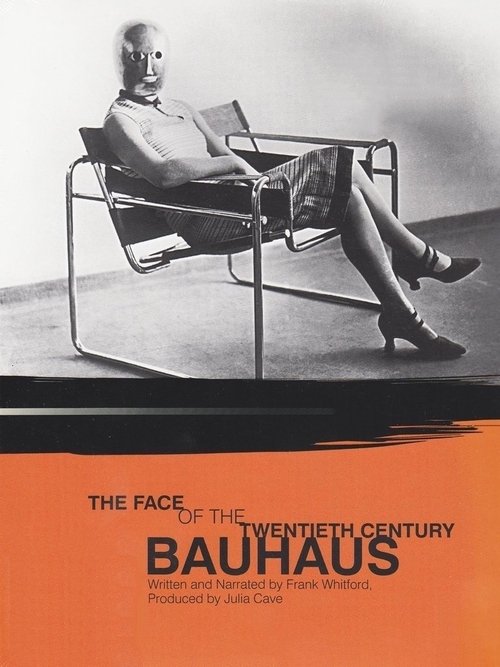
Bauhaus: The Face of the Twentieth Century
Sat, 01 Jan 1994
Bauhaus - The Face of the 20th Century, written and narrated by Frank Whitford, is an art documentary depicting the visual science generated from the outpouring of avant-garde ideas of this innovative educational undertaking.
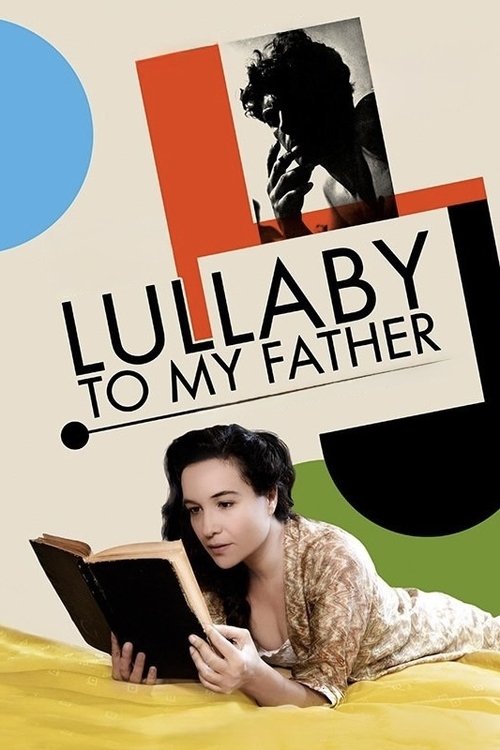
Lullaby to my Father
Tue, 30 Oct 2012
The film intertwines historical events and intimate memories. I observe how architecture represents the transformations of society and those who give form to this architecture. We follow the journey of Munio, my father, born in 1909 in Silesia, Poland, the son of a tenant farmer of a Prussian junker. At the age of 18, Munio goes to Berlin and Dessau to meet Walter Gropius, Kandinsky and Paul Klee at the Bauhaus. In 1933, the Bauhaus was closed by the Nazis, who accused Munio of treason against the German people. Munio was imprisoned, then deported to Basel. He left for Palestine. Upon his arrival in Haifa, he began a career as an architect and adapted European modernist principles to the Middle East.
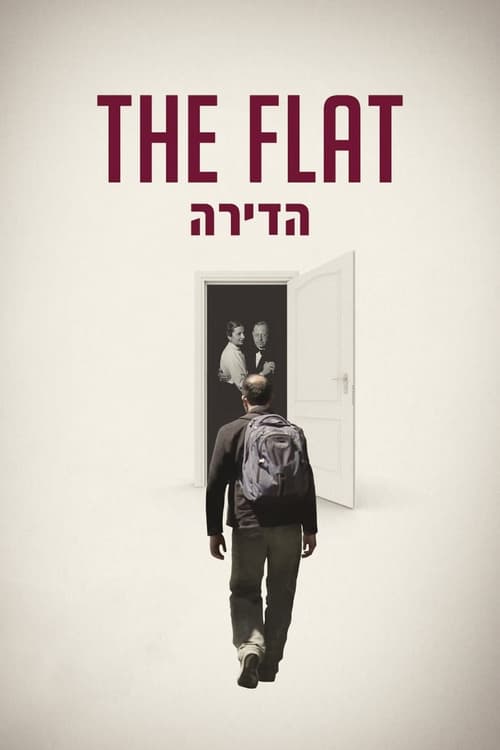
The Flat
Mon, 11 Jul 2011
The flat on the third floor of a Bauhaus building in Tel Aviv was where my grandparents lived since they immigrated to Palestine in the 1930s. Were it not for the view from the windows, one might have thought that the flat was in Berlin. When my grandmother passed away at the age of 98 we were called to the flat to clear out what was left. Objects, pictures, letters and documents awaited us, revealing traces of a troubled and unknown past. The film begins with the emptying out of a flat and develops into a riveting adventure, involving unexpected national interests, a friendship that crosses enemy lines, and deeply repressed family emotions. And even reveals some secrets that should have probably remained untold...
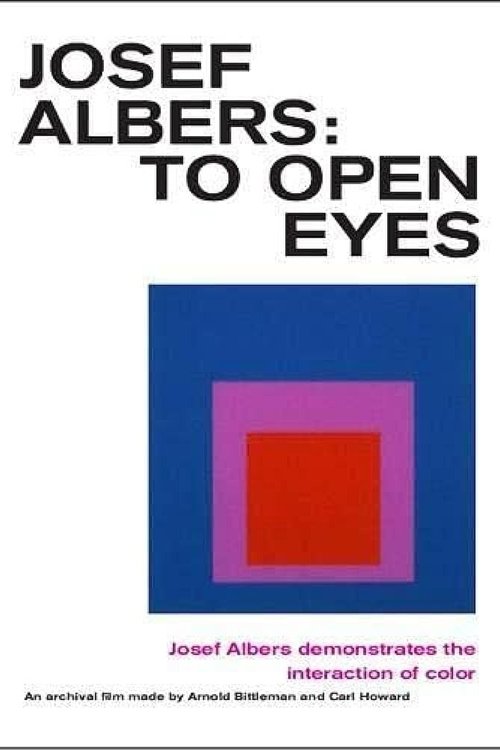
To Open Eyes
Invalid Date
The genesis of To Open Eyes: A Film on Josef Albers developed from Arnold Bittleman's appreciation for Albers while Bittleman was a student at Yale University in the 1960s. Wanting to preserve Albers’s teaching method—learning by doing—Bittleman set out with filmmaker and editor Carl Howard to make a visual record of Albers teaching students how to see and use color as a visual grammar. The film includes archival footage of Josef Albers at home in conversation with Bittleman, as well as footage from Black Mountain College and Yale University.
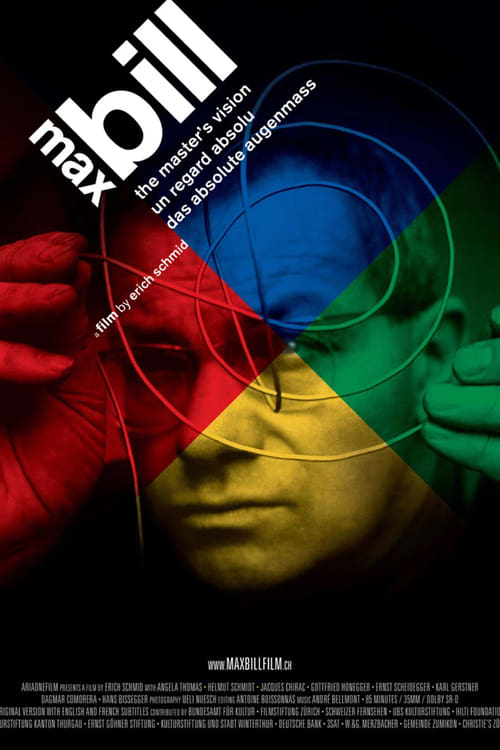
Max Bill: The Master's Vision
Sun, 10 Aug 2008
The film about Max Bill (1908-1994) moves between the dynamic fields of art, aesthetics and politics. Max Bill was probably the most important swiss artist of the 20th century and the most famous student to come out of the legendary Bauhaus in Dessau. He was an ardent anti-fascist and all his avant-garde work as an artist, sculptor, architect and typographer showed a social responsibility and environmental awareness right through his life. His views have become incredibly topical.
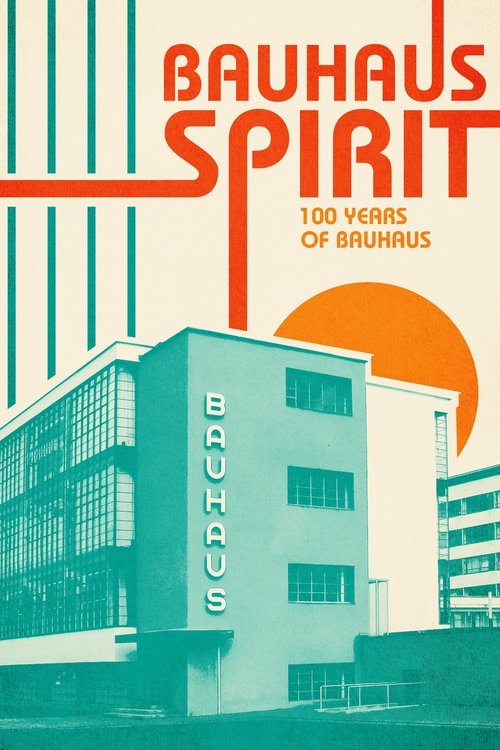
Bauhaus Spirit: 100 Years of Bauhaus
Thu, 26 Apr 2018
Founded in 1919 by Walter Gropius, Bauhaus was supposed to unite sculpture, painting, design and architecture into a single combined constructive discipline. It is a synthesis of liberated imagination and stringent structure; cross-medial concepts that embellish and enrich our existence, illumination and clarity, order and playfulness. But Bauhaus was never just an artistic experiment. Confronted with the social conditions of that particular time, as well as the experience of WWI, the movement concerned itself with the political and social connotations of design from the very outset. Hence, Bauhaus history is not just the history of art, but also the history of an era that stretches from the early 20th century to the modern day.

Functional Block Diagrams
Invalid Date
A synthesis of sound and movement; colourful characters dance and move in repetitive patterns to percussive and melodic elements. A combination of motion and music that is hypnotic and beautiful. At first it feels structured and orderly but as more elements are added becomes quixotically expressive.

Man and Mask, Oskar Schlemmer and the Bauhaus Stage
Wed, 01 Jan 1969
Documentary on the design and choreography of Oskar Schlemmer (1888-1943), an artist and teacher associated with the Bauhaus. After a discussion of his artistic philosophy and goals, illustrated by his drawings, reconstructions of his choreographic works are seen in action, each with a brief introduction.
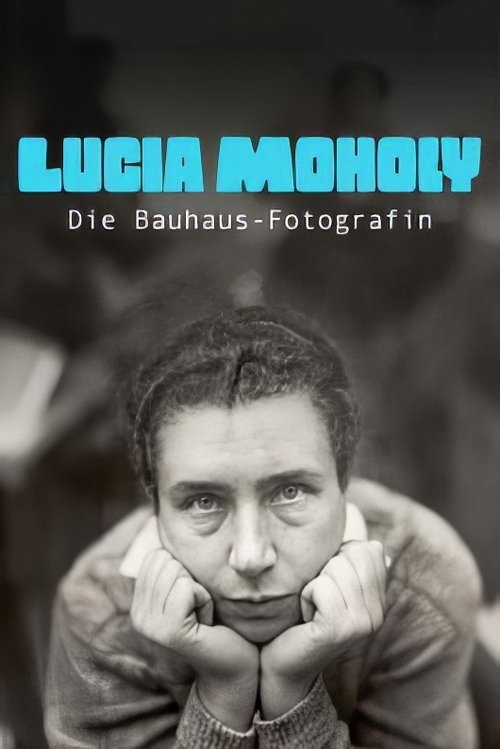
Lucia Moholy, la photographe du Bauhaus
Mon, 10 Feb 2025
As a Bauhaus photographer, Lucia Moholy (1894-1989) was a pioneer of New Objectivity. Her husband László Moholy-Nagy was appointed to the Bauhaus in 1923. They worked there together and László became famous as the inventor of the photogram, a photo without film. Lucia's contribution to this only became known later. When the Czech-born Jew was forced to leave Germany in 1933 after the Nazis seized power, she was unable to take her most important possession, her glass negatives, with her. She struggled to keep her head above water in London and worked for the British secret service on the microfilming of valuable documents. With her vision of microfilm as freely accessible information for all, she is now regarded as a pioneer of the Internet. After the war, Lucia set out in search of her glass negatives.

Modulaciones en la Terraza
Tue, 31 Mar 2015
Film made with two photographs taken at the Unité d’Habitation, built by Le Corbusier in Marseille. For the editing the film are used a film adaptation of the rules of the Modulor, measurement system designed by Le Corbusier himself. Includes a tribute to Paul Sharits and another to Agnès Varda.
Oskar Schlemmer and Dance
Tue, 01 Jan 1980
Original film material from the Bauhaus dances of Oskar Schlemmer.

Stage and Dance
Wed, 01 Jan 2014
Walter Gropius saw stage design as an interplay of various disciplines, comparable to architecture, forming an "orchestral unity." From the structural affinity of the two arts, he derived the necessity of establishing a Bauhaus stage. Here, the fundamental elements of "stage design" were to be examined and reformulated. At the center of the Bauhaus stage was Oskar Schlemmer, who headed the stage workshop from 1923 to 1929. With his Triadic Ballet and the Bauhaus Dances, he explored the tension between people and space, and thus the fundamental conditions of theatrical design, through abstract and geometric play with form, color, sound, movement, and light.

The Triadic Ballet
Sat, 11 Apr 1970
A film in three parts after Oskar Schlemmer's Triadische Ballett (Triadic Ballet).
Gerhard Bohner: Dancer and Choreographer
Sun, 01 Jan 1984
Short documentary on the reconstruction of the Bauhaus dances of Oskar Schlemmer by Gerhard Bohner.